

The headline corporate tax rate in China in 2026 is 25%, but most foreign companies pay less. Standard CIT is 25%, with reduced rates of 15% for High-and-New Technology Enterprises (HNTE), an effective 5% for Small Low-Profit Enterprises (SLPE) on the first RMB 3 million of taxable income, and as low as 15% in specific Free Trade Zone programs. VAT runs at 13%, 9% or 6% depending on what you sell. Individual Income Tax (IIT) climbs from 3% to 45% across seven brackets, with foreign-talent caps in Qianhai and Hainan limiting the effective rate to 15% for qualifying roles. Withholding tax on dividends out of China is 10%, dropping to 5% under most treaties.

That single paragraph is the answer most pages stop at. The real complexity for a foreign founder, finance director, or expat in 2026 is in the layers — when each rate applies, which exemptions are realistic, and what the effective tax bill actually looks like once you stack CIT, VAT, IIT, surcharges, and withholding.

This guide is the consolidated 2026 version. One page, every rate, every bracket, every exemption that matters for foreign-invested companies and foreign individuals working in China — sourced from the State Taxation Administration and updated for the 2026 policy environment.

Shanghai China

Send us your questions and we will answer within 24 hours Message  →

The 2026 China Tax Rates at a Glance

Standard rates per State Taxation Administration [1]; SLPE/VAT extensions per State Council [3].

TaxRateNotes
Corporate Income Tax — standard25%Domestic & foreign-invested companies
CIT — High-and-New Tech Enterprise15%Valid HNTE certificate required
CIT — Small Low-Profit Enterprise5% effectiveFirst RMB 3M; extended through 2027
CIT — FTZ-qualifying15%Lin-gang, Qianhai, Hainan
VAT — most goods13%General taxpayer
VAT — transport, basic goods9%General taxpayer
VAT — services & intangibles6%General taxpayer
VAT — small-scale taxpayer1% (through 2027)Annual revenue ≤ RMB 5M
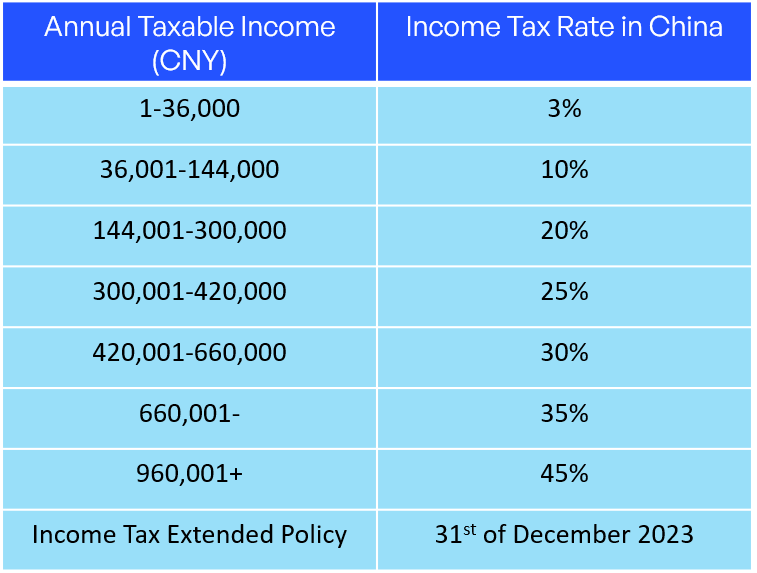
Individual Income Tax3% – 45%7 brackets, RMB 60,000 deduction
Withholding Tax on outbound dividends10% standard5% under HK/SG/UK/EU treaties

Corporate Income Tax (CIT) in 2026

China’s standard CIT rate is 25%. It applies to every tax-resident enterprise — every company incorporated in China, plus any foreign company with its place of effective management in China — and to non-resident companies on their China-sourced business income. There are no provincial CIT add-ons, which makes the headline rate cleaner than the U.S. or German equivalents.

The standard 25% rate

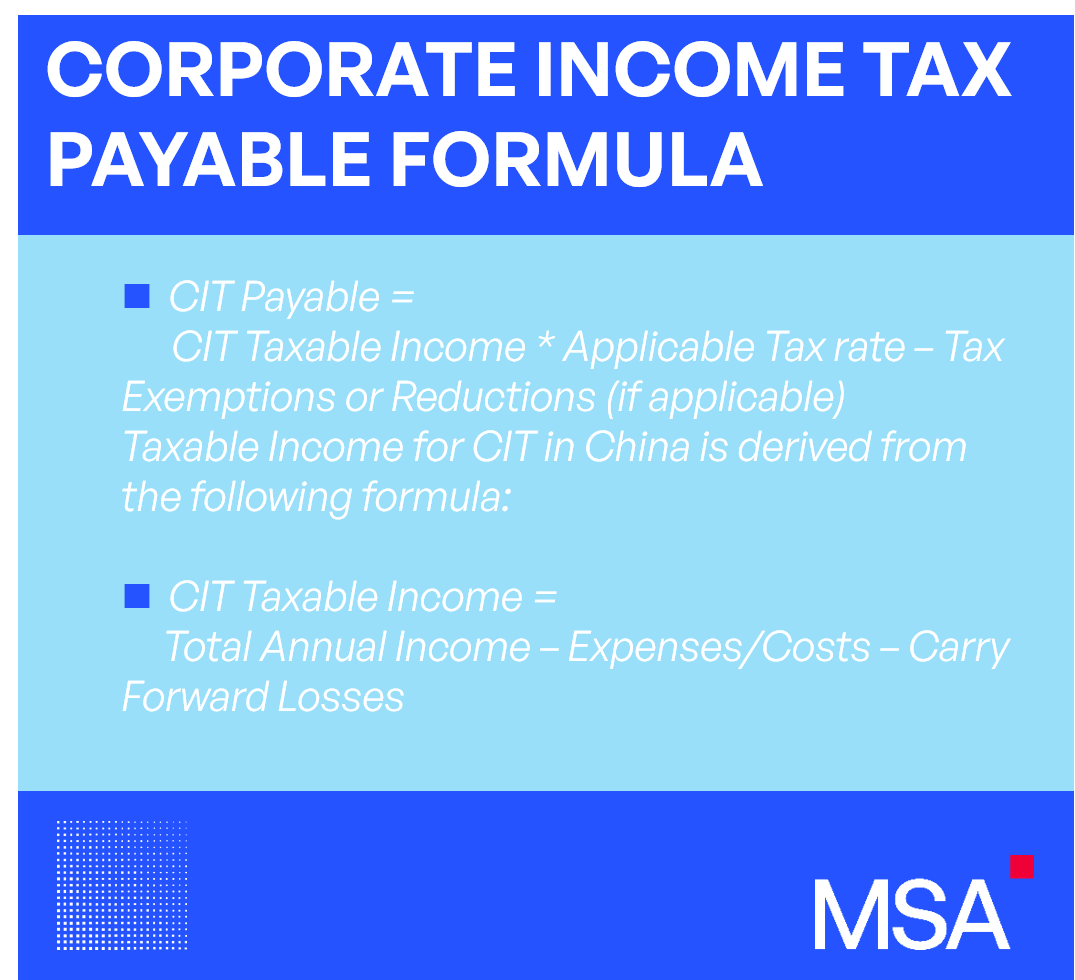
The 25% is calculated on taxable income: gross revenue minus deductible costs, allowable expenses, depreciation, R&D super-deductions, and prior-year losses (carried forward up to 5 years; 10 years for HNTEs and qualifying tech enterprises).

15% for High-and-New Technology Enterprises (HNTE)

If your Chinese company holds a valid HNTE certificate, your CIT rate drops to 15% for the certificate’s three-year validity period (renewable). The qualifying tests are real: IP rights to core technology in one of eight encouraged HNTE fields; R&D personnel ≥ 10% of total headcount; R&D spending above the revenue-tiered threshold (5% if under RMB 50M revenue, 4% under RMB 200M, 3% above); high-tech products/services contributing ≥ 60% of total revenue.

Genuine software, biotech, advanced manufacturing, and certain hardware businesses qualify regularly.

The R&D super-deduction (most under-used lever)

Through December 31, 2027, eligible R&D spending is deductible at 200% of the actual amount for most companies, and 220% for integrated-circuit and CNC machine-tool sectors. RMB 1 million of qualifying R&D becomes RMB 2 million of deduction — a real cash effect on the CIT bill, even before HNTE status is layered on top.

Small Low-Profit Enterprises — the 5% effective rate

The most-misquoted China tax rate. Companies with annual taxable income ≤ RMB 3 million, headcount ≤ 300, and total assets ≤ RMB 50 million pay an effective 5% on the full RMB 3 million through December 31, 2027 [3]. The legal mechanism is a 25% reduction applied to a 20% rate. Most early-stage WFOEs qualify.

Value-Added Tax (VAT) in 2026

The three general-taxpayer bands

  • 13% — most physical goods, processing, repair
  • 9% — transport, postal, telecommunications, basic agricultural goods, utilities
  • 6% — most services, intangibles, financial services, leasing of immovables

A general taxpayer can deduct input VAT against output VAT.

Small-scale taxpayer — 3% (currently 1%)

A company with annual VATable revenue at or below RMB 5 million can register as a small-scale taxpayer and apply a flat 3% rate. Under the small-business support policy currently extended through December 31, 2027, this is reduced to 1% effective [3]. Small-scale taxpayers cannot deduct input VAT and cannot issue special VAT invoices.

VAT surcharges

On top of VAT itself, a Chinese company pays UMCT (7%/5%/1% by location), Education Surcharge (3% of VAT), and Local Education Surcharge (2% of VAT). In a major city, the surcharge load adds roughly 12% of the VAT amount.

The fapiao system

China’s tax-invoice (fapiao) system is enforced rigorously. Issuing a special VAT invoice to a customer lets them deduct input VAT — refusing kills B2B relationships. The golden tax system electronically validates every fapiao, so quota is managed by your tax bureau.

Individual Income Tax (IIT) in 2026

Tax-resident vs non-resident — the 183-day rule

You’re a Chinese tax resident if you reside in China for 183 days or more during the calendar year. Tax residents are taxed on worldwide income. Non-residents are taxed only on China-source income.

A separate “six-year rule” softens the worldwide-income hit for foreign tax residents: if you leave China for more than 30 consecutive days in any year of a six-year window, the worldwide-income clock resets. Most well-advised expats use this rule deliberately.

IIT brackets — comprehensive income

After the RMB 60,000 standard deduction and any special additional deductions, your annual taxable income flows through these progressive brackets:

Annual taxable income (RMB)IIT rateQuick deduction (RMB)
Up to 36,0003%0
36,001 – 144,00010%2,520
144,001 – 300,00020%16,920
300,001 – 420,00025%31,920
420,001 – 660,00030%52,920
660,001 – 960,00035%85,920
Above 960,00045%181,920

Formula: IIT = (taxable income × rate) − quick deduction.

Special additional deductions — what to claim

Beyond the RMB 60,000 standard deduction, residents can stack: children’s education (RMB 2,000/month per child); continuing education (RMB 400/month); major medical expenses (above RMB 15,000, capped at RMB 80,000); first-home mortgage interest (RMB 1,000/month); rental (RMB 800–1,500/month by city); elderly care (RMB 3,000/month).

Foreign talent allowances and FTZ caps

Foreign individuals can receive certain non-cash benefits tax-free if properly structured: housing rental, children’s tuition at international schools, language training, home-leave flights, meal allowances. The transitional rule keeping these allowances available for foreigners has been extended through December 31, 2027. For most senior-pay foreign hires, the foreigner-specific allowances still beat the general regime materially.

In Shenzhen Qianhai and across Hainan FTP, qualifying foreign talent benefits from an effective IIT cap of 15% — the local government refunds the portion above 15% via a quarterly subsidy.

Foreigner FAQ — what does my IIT actually look like?

If you’re a foreign individual earning RMB 50,000/month gross in Shanghai, claiming standard deduction and reasonable special additional deductions, your effective IIT rate typically lands between 22% and 28%. The exact number depends on housing, family situation, and whether you elect the foreigner allowance regime. Try the inputs in our China tax calculator for a directional figure, and see the Average Salary in China 2026 guide if you need to benchmark gross pay before running the calculation.

Withholding Tax for Non-Resident Enterprises

When your Chinese company pays profits, interest, royalties, or rent to a foreign parent or counterparty, China withholds tax at source. The statutory rate is 20%, temporarily reduced to 10% under State Council circulars in continuous extension — so 10% is the rate practitioners actually apply in 2026. Treaty relief is layered on top.

Treaty matrix — selected jurisdictions (dividends out of China) [4]

Recipient jurisdictionTreaty rateNotes
Hong Kong5%If shareholder owns ≥ 25% — the HK holdco play
Singapore5%Same ≥ 25% threshold
United Kingdom5%Same ≥ 25% threshold
Germany / France / Netherlands5% / 10%Stepped on shareholding
United States10%No treaty reduction below 10%
Australia15%Higher than statutory
BVI / Cayman10%No treaty

The Hong Kong route is why so many foreign founders structure their China entry as HK Holdco → Mainland WFOE. A 5% withholding instead of 10% (US-direct) saves real money on every repatriation. To actually apply the treaty rate, you need a tax-residency certificate from the recipient’s tax authority and to file the treaty-benefit claim with the Chinese paying agent before the dividend goes out.

Tax-clearance certificate to remit

Even after withholding, you need a tax-clearance certificate from the Chinese tax bureau to push the post-tax dividend through SAFE (foreign-exchange control). This is the single most-skipped step in foreign-funded structures — and the reason cash often gets stuck in China after year-end.

Other Taxes Foreign-Invested Companies Should Know

Beyond CIT, VAT, and IIT, a few smaller taxes routinely appear: Stamp Tax (0.005%–0.1% on contracts/registers); Real Estate Tax (1.2% on residual property value, or 12% on rental income); Land Appreciation Tax (30%–60% progressive on real-estate gains); Customs Duty + Import VAT (HS-code dependent + 13%/9%); Environmental Protection Tax (provincial rates on pollutant emissions).

For a non-manufacturing services company, the realistic universe is CIT + VAT + IIT (employees) + Stamp Tax. For a trading WFOE, add customs and import VAT. For a manufacturer, add Environmental Protection Tax.

Filing Calendar — What’s Due When

Plan the compliance year around these dates. Missing any of them risks “abnormal operation” status, frozen bank accounts, and bars on the legal representative leaving the country.

  • Monthly (15th): VAT, surcharges, IIT withholding for the prior month
  • Quarterly (15th of month following quarter): Provisional CIT, social-insurance reconciliations
  • By March 31: SAFE annual FX inspection
  • By April 30: SAMR annual public report
  • By May 31: Annual CIT reconciliation and prior-year audit report
  • By June 30: Annual IIT settlement for individuals (residents only)

Common Mistakes That Trigger Penalties

Misclassifying small-scale vs general taxpayer status. Picking small-scale to chase the 1% VAT looks attractive until your B2B customers can’t claim input VAT and stop buying.

Failing to apply the treaty rate on outbound dividends. Without the residency certificate filed in time, the treaty 5% becomes the statutory 10%.

Letting employees stay over 183 days while assuming non-resident status. A foreigner crosses 183 days and becomes a worldwide-income tax resident — usually retroactively. The single most-expensive expat surprise.

Skipping the annual audit. Mandatory for every WFOE, JV, and Rep Office. Skip it and you’re downgraded to “abnormal operation,” freezing accounts and barring the legal rep from leaving China.

Confusing the headline rate with the effective rate. “China CIT is 25%” is true and misleading. For most early-stage WFOEs the effective rate is materially lower once SLPE, HNTE, or FTZ programs apply.

Frequently Asked Questions

What is the corporate tax rate in China in 2026?

The standard CIT rate is 25%. Reduced rates: 15% for HNTE and qualifying FTZ companies; an effective 5% for SLPE on the first RMB 3M of taxable income (extended through 2027).

What is the VAT rate in China in 2026?

13% on most goods, 9% on transport / utilities / basic goods, 6% on most services. Small-scale taxpayers (revenue ≤ RMB 5M) pay a flat 3%, currently reduced to 1% through Dec 31, 2027.

What is the income tax rate in China for foreigners?

Foreign individuals are taxed on the same progressive 3%–45% IIT scale on China-source income. If they reside in China 183+ days they become tax residents and are also taxed on worldwide income (subject to the six-year rule). FTZ talent caps in Qianhai and Hainan reduce the effective rate to 15% for qualifying roles.

How much tax do you pay in China?

Total tax depends on your role. A foreign-invested services company typically pays 25% CIT plus 6% VAT on outputs (less input VAT credits) plus 7% urban maintenance and education surcharges on the VAT. A salaried foreign employee in Shanghai earning ¥30,000/month pays roughly ¥4,000 in IIT after the standard deduction (~13% effective). The cumulative effective tax rate on a profitable foreign-invested entity sits between 28% and 32% in most service-sector cases.

Are taxes high in China compared to the US?

For corporates, China’s 25% CIT is slightly higher than the US federal corporate rate of 21% but in the same band as California’s combined federal-and-state rate. For individuals, China’s top IIT bracket of 45% (above ~RMB 960k taxable annually) is higher than the US top federal rate of 37% — but kicks in at a higher absolute income level. For middle-income earners, effective tax on salary in China is comparable to the US.

Is it cheaper to live in China or the USA after taxes?

Yes, China is significantly cheaper after-tax for most middle-income earners. A ¥30,000/month salary in Shanghai (~US$4,170 gross, ~US$3,580 after IIT) goes further than a US$5,000/month salary in New York after federal, state, city tax, FICA and rent. Cost-of-living differential roughly cancels the rate differential.

What are the China income tax brackets in 2026?

Annual taxable income in RMB, after standard deduction of RMB 60,000:

  • Up to ¥36,000 → 3%
  • ¥36,001–¥144,000 → 10%
  • ¥144,001–¥300,000 → 20%
  • ¥300,001–¥420,000 → 25%
  • ¥420,001–¥660,000 → 30%
  • ¥660,001–¥960,000 → 35%
  • Above ¥960,000 → 45%

Is there a tax treaty between China and the US?

Yes. The US-China tax treaty was signed in 1984 and reduces withholding on US-China cross-border dividends, interest and royalties. The treaty has not been comprehensively updated since signing — meaning some routes (notably dividends to Hong Kong holding companies, then onward to the US) are more efficient than direct US-to-China structures.

What is the withholding tax on dividends out of China?

The default withholding tax on dividends paid out of a Chinese company to a foreign parent is 10%. Treaty rates can reduce this to 5% for most major jurisdictions (including Hong Kong, Singapore, Netherlands and the United Kingdom) provided the recipient meets beneficial-ownership requirements. Tax clearance is required before the bank will execute the remittance.

How does China tax foreign companies without a Chinese entity?

Foreign companies without a permanent establishment in China but earning China-source income (royalties, service fees, dividends, interest) are subject to withholding tax at 10% on the gross amount. Treaty relief can reduce this further. Operating through a representative office or branch creates different obligations — see our Representative Office and Branch Office guides.

Where can I find official China tax information?

The State Taxation Administration of the PRC publishes all current rates and policy bulletins at chinatax.gov.cn. For English-language official summaries, see the PwC Worldwide Tax Summaries China page. Regional Tax Bureau offices also publish city-level surcharges and FTZ-specific incentives that don’t appear in the national bulletins.

Last updated: 8 May 2026. For tailored advice on your specific structure or filings, see our China Tax Advisory service or get in touch with MSA Asia.

Key Takeaways

There’s no single China tax rate — there’s a stack of them, and the effective number you actually pay depends on entity choice, FTZ eligibility, taxpayer classification, and treaty network. The headline numbers in 2026 are broadly comparable to OECD norms; the complexity is in the combination, and the compliance calendar is unforgiving of mistakes.

References

#SourceWhat it covers
[1]State Taxation Administration of China (STA)Standard CIT 25%, VAT bands 13/9/6%, IIT 3–45% bracket schedule, withholding tax
[2]Ministry of Commerce (MOFCOM)2024 Negative List (31 items nationwide / 27 in FTZ)
[3]State Council Circular on Small Business Tax Support, extended through Dec 31, 20271% VAT for small-scale taxpayers, 5% effective CIT for SLPE
[4]PwC Tax Summaries — ChinaTreaty withholding rates cross-check
[5]2024 Company Law amendment (in force July 2024)5-year capital injection rule for new WFOEs
[6]State Council R&D Super-Deduction Notice (extended through Dec 31, 2027)200% / 220% R&D super-deduction multipliers
Related MSA Asia services